
Table of contents
Americans Rely on Online Retirement Calculators 2.5x More Than Financial Advisors
Report Highlights
Our 694-respondent survey shows a growing divide between retirement aspirations and financial reality, with online calculators emerging as the most commonly used planning tool ahead of financial advisors.
Key Findings
- 17% of Americans expect to retire at 70 or later, or never retire, compared to just 5% who desire this outcome
- 67% want to retire before age 65, but only 55% expect to do so
- 60% use online retirement calculators, making them the most commonly used planning tool
- 24% have visited a financial advisor locally for retirement planning
- 20% already use AI-powered retirement planning tools
- 9% report being fully confident their retirement plan will succeed
- 82% have started saving, yet significant gaps remain in savings levels and expectations
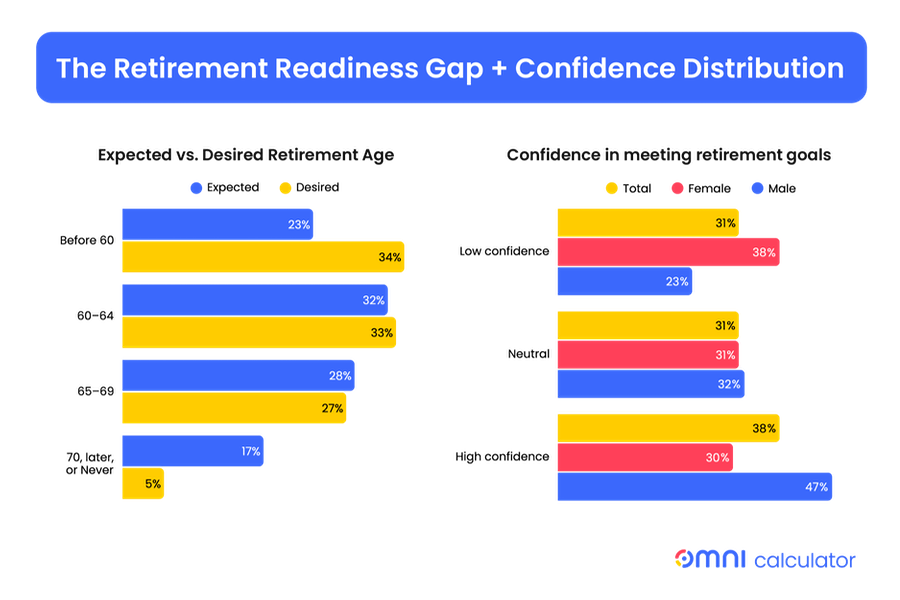
67% of Americans want to retire before age 65, while only 55% expect to do so. This gap highlights a disconnect between retirement aspirations and financial expectations.
The most common “dream” retirement age is before 60, selected by 34% of respondents. However, expectations shift later in life, with a growing share anticipating retirement at 65 or beyond.
This shift is most visible at the extremes. While only 5% of Americans say they want to work past age 70 or never retire, 17% expect this will be their reality, a 12-point increase in perceived forced late retirement. This sense of delayed or unattainable retirement is consistent with broader national sentiment. This finding aligns with broader national research: Western & Southern Financial Group found that nearly 20% of Americans fear they may never be able to retire, reinforcing that long-term retirement insecurity is a consistent theme across studies (1).
Despite widespread participation in retirement planning and saving, actually achieving a secure retirement remains limited.
- Low confidence (1-2): 31%
- Neutral (3): 31%
- High confidence (4-5): 38%
- Fully confident (5 only): 9%
🙋 Fewer than 1 in 10 respondents report being fully confident in their retirement readiness.
Confidence levels vary significantly by gender. Confidence levels vary significantly by gender. Men report higher confidence in retirement outcomes, with 47% selecting high confidence (4-5), compared to 30% of women.
While most Americans express clear retirement goals, participation in planning and saving remains uneven.
Have you started actively planning for your retirement?
Yes | Somewhat | No | |
|---|---|---|---|
Female | 43% | 33% | 24% |
Male | 63% | 20% | 16% |
Milllennials | 52% | 28% | 21% |
Gen X | 53% | 26% | 21% |
West | 49% | 33% | 18% |
Midwest | 54% | 27% | 19% |
Northeast | 56% | 29% | 15% |
South | 50% | 24% | 26% |
Total | 52% | 27% | 21% |
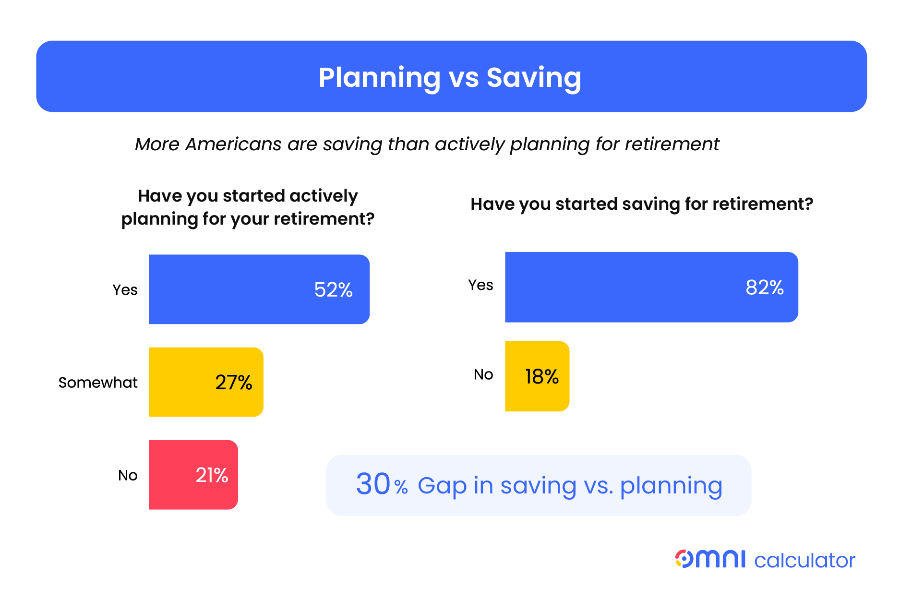
Nearly 1 in 5 Americans has not yet begun planning for retirement; a striking figure given that the majority report having clear goals.
Planning vs. Saving
There is a meaningful gap between those who are saving and those who are actively planning. Men are 20 percentage points more likely to have actively started planning than women (63% vs. 43%). At the same time, 24% of women say they have not begun planning at all, versus 16% of men. This may reflect structural factors such as the gender pay gap, career interruptions, or lower exposure to workplace retirement programs, all of which can make retirement feel like a distant priority.
Have you started saving for retirement?
Yes | No | |
|---|---|---|
Female | 78% | 22% |
Male | 87% | 13% |
West | 84% | 16% |
Midwest | 81% | 19% |
Northeast | 88% | 12% |
South | 77% | 23% |
Total | 82% | 18% |
Saving behavior shows a similar, though less pronounced, pattern. While 87% of men report having started saving for retirement, 78% of women have done the same.
Generational differences, however, are minimal. Millennials and Gen X report nearly identical levels of planning activity, suggesting that the retirement preparation challenge is not a generational problem, but an American one.
While planning behaviors are relatively consistent across the country, actual savings rates show statistically significant regional differences (p = 0.034). Northeast leads in participation, with 88% of respondents having started saving, while the South shows the highest level of non-participation at 23%. This divide may reflect differences in median income, cost-of-living pressures, or access to employer-sponsored retirement programs across regions.
U.S. adults say they’ll need $1.46 million on average to retire comfortably, according to Northwestern Mutual’s 2026 Planning and Progress Study (2). A figure our own data broadly supports, with 54% of respondents targeting $1 million or more. The savings gap reflects the difference between what Americans have accumulated and what they believe they need to retire comfortably.
Current Savings: The Generational Wealth Divide
Despite widespread participation in retirement savings programs, wealth accumulation remains highly uneven across the population.
There is a statistically significant difference in how much Millennials and Gen X have managed to save (p < 0.001).
- Only 6% of Millennials have saved more than $500,000, compared to 20% of Gen X.
- However, both generations show similar levels of financial vulnerability: 21% of Millennials and 23% of Gen X have less than $10,000 saved.
Gen X holds more of the “high-wealth” accounts, but in both generations, many people are approaching retirement with little to no liquid assets.
The Gender Wealth Gap
Retirement savings also vary significantly by gender (p = 0.0008), reflecting persistent structural differences in financial preparedness.
- One-quarter (25%) of women have less than $10,000 saved for retirement, compared to 17% of men.
- Men are twice as likely as women to have saved $500,000 or more (14% vs. 7%).
Women are more likely to enter retirement with a financial deficit, compounding earlier gaps observed in planning activity and confidence levels.
What Americans Want to Have
Financial expectations further widen the gap between current savings and perceived retirement needs.
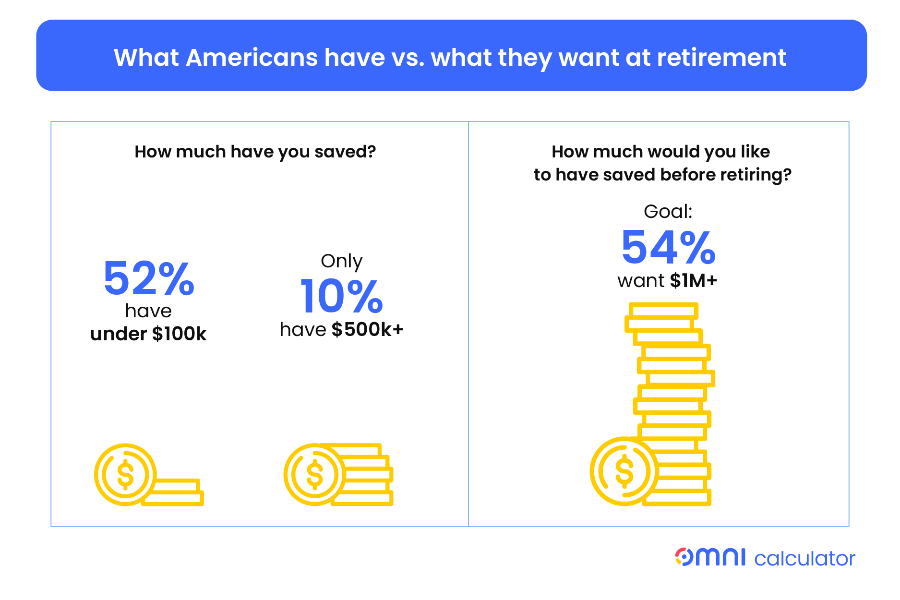
The Millionaire Dream is alive. Over half of all Americans (54%) believe they need $1,000,000 or more to retire.
- 57% of Millennials are aiming for $1M+, compared to 45% of Gen X (p = 0.0003); and
- 60% of men target $1M+, compared to 48% of women (p = 0.002).
🔎 There is a major disconnect between current savings and these goals. While 54% of people want $1M+, currently only 10% of the population has even half that amount ($500k) saved.
One of the clearest behavioral shifts in the data is how Americans approach retirement planning tools. While financial advisors remain the most trusted source of guidance, most individuals now begin their planning journey using digital tools.
Which of the following steps have you taken toward retirement planning?
Total | Female | Male | Millennials | Gen X | West | Midwest | Northeast | South | |
|---|---|---|---|---|---|---|---|---|---|
Used online retirement calculators | 60% | 56% | 65% | 58% | 67% | 65% | 59% | 64% | 57% |
Used online retirement platforms/apps | 55% | 52% | 59% | 60% | 45% | 61% | 55% | 55% | 52% |
Visited a financial advisor locally | 24% | 24% | 24% | 25% | 22% | 26% | 30% | 21% | 20% |
Created a written or digital plan | 23% | 21% | 24% | 24% | 20% | 29% | 18% | 21% | 25% |
Used AI-powered planning | 20% | 16% | 24% | 22% | 15% | 20% | 20% | 23% | 18% |
Attended a seminar/webinar | 13% | 15% | 12% | 11% | 17% | 13% | 14% | 15% | 12% |
Humans vs. Online Tools
Americans continue to value professional advice but increasingly rely on self-service tools to take the first step — using online retirement calculators 2.5x more than visiting a financial advisor (60% vs. 24%).
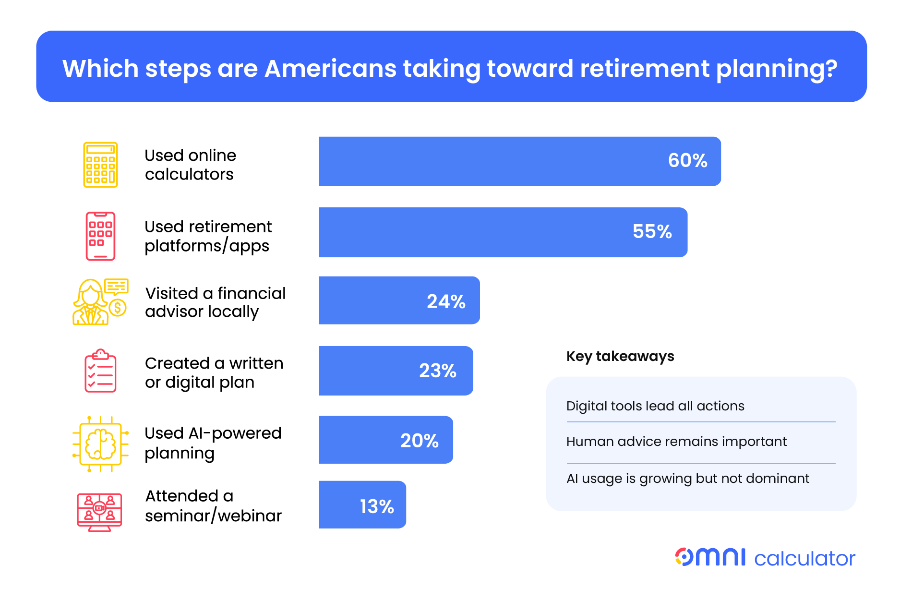
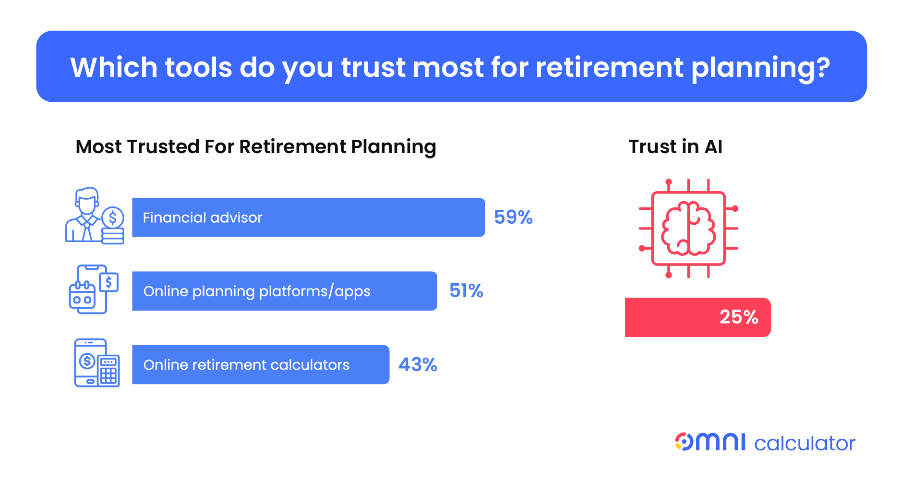
Financial advisors remain the most trusted source of guidance (59%), though online planning platforms are closing the gap rapidly, trusted by 51% of respondents. Yet despite this trust, only 24% of Americans have actually visited a local advisor — suggesting that trust alone isn't enough to drive action.
Online Retirement Calculators are the most widely used tool in the retirement planning landscape (60%), and they sit at the top 3 most trusted tools (43%).
AI-powered retirement tools remain in early adoption at 20%, but generational trends suggest this share is likely to grow.
Apps for Millennials, Calculators for Gen X
There are statistically significant differences in how the two generations interact with planning technology.
- Online Apps: Millennials are significantly more likely to use and trust online planning platforms/apps than Gen X (p < 0.001). 60% of Millennials use these apps compared to 45% of Gen X.
- Calculators: Conversely, Gen X leans more heavily on "pure" calculation tools. 67% of Gen X use online retirement calculators compared to 58% of Millennials (p = 0.034).
- AI Adoption: AI-powered planning is still in its infancy but shows a generational divide approaching significance (p = 0.0506), with 22% of Millennials trying AI tools compared to 15% of Gen X.
The Gender Digital Divide
Gender also plays a significant role in the adoption of new financial technologies (p < 0.05 for usage).
- Men are significantly more likely to use Online Calculators (65% vs. 56%) and AI-powered planning (24% vs. 16%) than women.
Which tools do you trust most for retirement planning?
Total | Female | Male | Millennials | Gen X | |
|---|---|---|---|---|---|
Financial advisor | 59% | 61% | 57% | 61% | 54% |
Online planning platforms/apps | 51% | 53% | 48% | 54% | 43% |
Online retirement calculators | 43% | 41% | 45% | 41% | 47% |
AI-powered planning tools | 25% | 23% | 26% | 26% | 23% |
Spreadsheet/manual tracking | 36% | 33% | 40% | 36% | 36% |
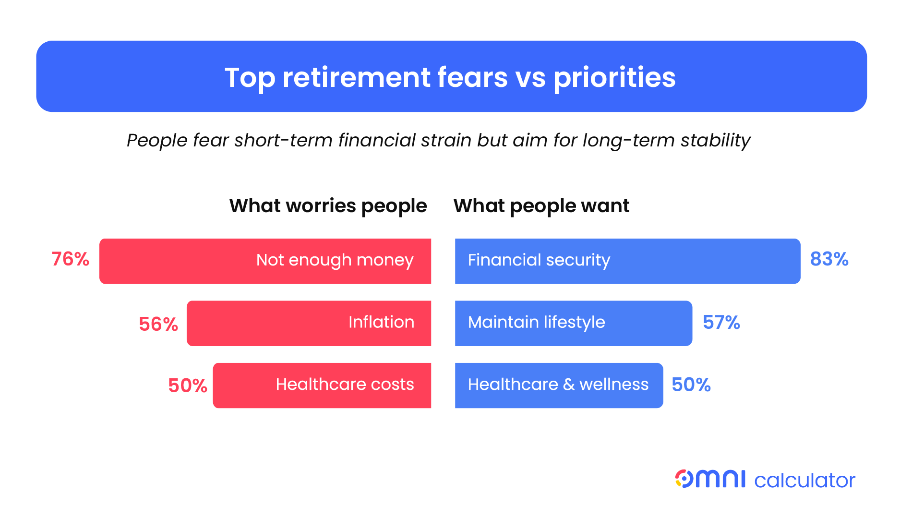
Americans report multiple structural and psychological barriers to retirement readiness. Our survey shows that while financial security is the ultimate goal, women and younger generations are facing significantly higher emotional and educational barriers.
What is your biggest challenge in planning for retirement?
Total | Female | Male | Millennials | Gen X | West | Midwest | Northeast | South | |
|---|---|---|---|---|---|---|---|---|---|
Not enough money | 76% | 80% | 70% | 76% | 74% | 74% | 74% | 74% | 78% |
Lack of knowledge | 28% | 35% | 21% | 31% | 22% | 28% | 32% | 23% | 29% |
Too many options/confusing | 27% | 29% | 25% | 30% | 21% | 24% | 29% | 33% | 23% |
Don’t know where to start | 16% | 21% | 11% | 18% | 12% | 16% | 13% | 18% | 18% |
Longevity Risk | 28% | 25% | 30% | 28% | 26% | 26% | 32% | 31% | 23% |
Tax planning | 26% | 23% | 31% | 27% | 24% | 26% | 33% | 31% | 18% |
Inflation | 56% | 53% | 61% | 57% | 55% | 64% | 57% | 56% | 54% |
Healthcare and long-term care costs | 50% | 48% | 53% | 47% | 58% | 57% | 49% | 54% | 46% |
The Biggest Barriers
- Financial pressure dominates: 76% of Americans cite “not enough money” as their biggest challenge, with women significantly more affected (80% vs. 70% of men).
- Knowledge gaps persist: Women are more likely to report a lack of knowledge (35% vs. 21%) and uncertainty about where to start (21% vs. 11%).
- Macro concerns are widespread: Inflation (56%) and healthcare costs (50%) are top concerns across all groups.
- Generational divide: Millennials are more likely to feel overwhelmed by complexity, while Gen X is more focused on healthcare costs as retirement approaches.
Retirement Priorities
Despite these barriers, priorities are consistent. Financial security is the top goal for 83% of Americans, followed by maintaining their standard of living (57%) and achieving debt-free status (37%). The desire for early retirement remains stronger among Millennials (34%) than Gen X (18%), reflecting the longer runway and perhaps greater optimism of younger workers.
What matters most to you in retirement?
Total | Female | Male | Millennials | Gen X | West | Midwest | Northeast | South | |
|---|---|---|---|---|---|---|---|---|---|
Financial security | 83% | 86% | 79% | 84% | 80% | 75% | 80% | 86% | 85% |
Maintaining standard of living | 57% | 57% | 56% | 57% | 58% | 60% | 50% | 58% | 60% |
Age of retirement / retiring early | 29% | 28% | 31% | 34% | 18% | 35% | 32% | 29% | 24% |
Debt-free status | 37% | 36% | 38% | 39% | 33% | 42% | 35% | 37% | 37% |
Health care & wellness | 50% | 51% | 48% | 48% | 55% | 47% | 50% | 49% | 52% |
Community involvement, work/volunteering | 6% | 6% | 5% | 6% | 4% | 1% | 7% | 4% | 8% |
Regional differences are limited but notable. Midwestern respondents are more likely to cite tax planning as a challenge (33% vs. 18% in the South), while Southern respondents place greater value on community involvement in retirement (8% vs. just 1% in the West).