
Table of contents
Evidence-Based Medicine Explained: The Four Statistical Pillars Every Clinician Must Know
Report Highlights
The rise of evidence-based medicine (EBM) has elevated statistical thinking from an academic concern into a core clinical competency. This requires professionals to engage not just with findings, but with the methodology that produced them.
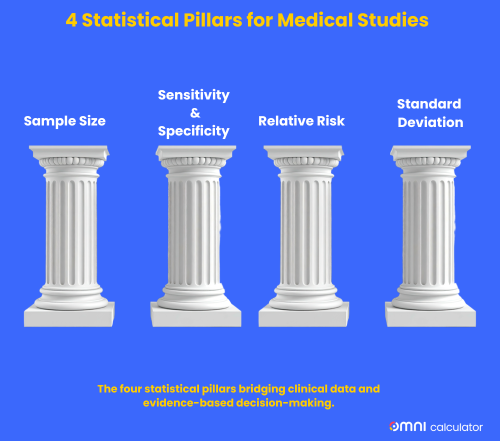
At the heart of this transformation lie four statistical pillars:
- Sample size calculation in medical studies;
- Sensitivity and specificity in diagnostic testing;
- Relative risk in cohort study; and
- Standard deviation in research.
Together, these concepts form the professional’s toolkit for evidence-based medicine, turning raw data into actionable medical knowledge.
No clinical study stands without the careful determination of who and how many study participants should be included. Sample size calculation in medical studies is the foundation of any well-designed trial. By choosing too few participants, the study risks being underpowered and unable to detect real differences between treatment groups, even when they exist. Choosing too many, on the other hand, easily leads to wasted resources and unnecessary patient enrollment, which could make the study ethically questionable.
The calculation itself depends on several interacting variables:
- Expected effect size;
- Desired statistical power (typically 80% or 90%);
- Significance threshold (alpha, commonly set at 0.05); and
- Variability of the outcome being measured.
A researcher studying a novel antihypertensive, for instance, must estimate how large a blood pressure reduction would be clinically meaningful, then calculate the number of patients needed to detect that reduction with sufficient confidence.
✅ 80% is the conventional minimum statistical power for clinical trials, reflecting the probability of detecting a true effect when one exists.
Underpowered studies remain one of the most common sources of false negatives in biomedical research. In practice, many published studies are retrospectively found to have been underpowered, which contributes to the reproducibility crisis in biomedical research. For clinicians appraising the literature, checking whether a study’s sample size was justified and whether a null result could simply reflect inadequate power is a critical reading skill.
When a test returns a positive result, how much should a clinician trust it? When it returns negative, can the disease truly be ruled out? These questions sit at the core of diagnostic medicine, and their answers depend entirely on two complementary statistics: sensitivity and specificity.
Sensitivity measures a test's ability to correctly identify true positives, patients who genuinely have the condition. A highly sensitive test misses a few cases, making it valuable for ruling out disease when negative. It uses the mnemonic SnNout, which stands for Sensitive, Negative, rules OUT:
- Sn (Sensitive): A test with high sensitivity (it detects most people who have the disease);
- N (Negative): The test result is negative; and
- Out (Rules Out): The negative result helps exclude the diagnosis.
In other words, if a test is highly sensitive and the result is negative, the disease is unlikely to be present.
Specificity, conversely, measures the ability to correctly identify true negatives. A highly specific test rarely yields a false-positive result, making it valuable for confirming disease when it is positive. Specificity is assessed via the SpPin: Specific, Positive rules in:
- Sp (Specific): A test with high specificity (it correctly identifies people who do not have the disease; few false positives);
- P (Positive): The test result is positive; and
- In (Rules In): The positive result helps confirm the diagnosis.
In other words, if a test is highly specific and the result is positive, the disease is likely to be present.
These two metrics do not exist in isolation. Sensitivity and specificity interact with disease prevalence through positive and negative predictive values (PPV and NPV), and they can be visualized through receiver operating characteristic (ROC) curves, which plot sensitivity against specificity across all possible diagnostic thresholds. For professionals validating, e.g., a new biomarker, calculating sensitivity and specificity in diagnostic testing is non-negotiable.
Epidemiology asks a deceptively simple question: Does exposure to this factor change the probability of this outcome? Relative risk (RR) is the primary metric through which that question is answered in cohort studies. The relative risk in a cohort study expresses the ratio of the risk of an event in an exposed group to the risk in an unexposed group.
An RR of 1.0 means no difference. An RR >1 indicates that the exposed group faces a higher risk and <1, a lower risk. A prospective cohort study finding that smokers have an RR of 14 for developing squamous cell lung carcinoma compared with non-smokers shows that exposed individuals are fourteen times more likely to develop the condition.
Yet relative risk can be deceptive in isolation. A large RR for a rare disease may translate into a small absolute risk increase, which is why clinicians must also consider the number needed to harm (NNH) or number needed to treat (NNT). These absolute measures anchor the relative result to a clinical reality, enabling effective, evidence-based medicine. Furthermore, in case-control studies, the relative risk cannot be calculated directly; the odds ratio (OR) serves as a proxy, and distinguishing between the two is essential when reading retrospective research.
Any single measurement, whether serum creatinine, a pain score, or systolic blood pressure, is only meaningful in the context of a distribution. Standard deviation (SD) is the statistical measure that describes how spread out the distribution is, i.e., how much individual values vary around the mean.
A small SD indicates homogeneity, where the measured values cluster tightly around the average. This suggests a consistent, predictable phenomenon. A large SD signals heterogeneity, with values widely dispersed, suggesting individual variability that may itself be clinically significant. In pharmacology, for instance, a drug with high inter-patient variability in plasma concentration (large SD) may require therapeutic drug monitoring even if its average concentration is therapeutic.
Standard deviation also underpins the construction of confidence intervals, the interpretation of z-scores, and the assumptions of parametric statistical tests. When researchers report that a new intervention reduced hemoglobin A1c by 0.8% ± 0.3% (mean ± SD), the SD is evidence that the estimate of effect is reliable and reproducible across the study population.
- Study design: sample size calculator — determining study cohorts;
- Diagnostic validation: sensitivity and specificity calculator — finding sensitivity, specificity, PPV, NPV, & likelihood ratios;
- Epidemiological risk: relative risk calculator — computing RR, odds ratios, and confidence intervals from cohort or case-control data; and
- Precision metrics: standard deviation calculator — calculating SD, variance, and standard error from raw data sets.
These statistical concepts are interconnected and frequently applied concurrently in clinical research. A rigorously designed randomized controlled trial typically incorporates each of these elements:
- Sample size calculations determine participant enrollment;
- Primary and secondary endpoints often utilize sensitivity and specificity to evaluate diagnostic accuracy;
- Efficacy is frequently reported as relative risk reduction; and
- Precision of statistical estimates is defined by standard deviations and confidence intervals.
Furthermore, a comprehensive understanding of these principles is essential for both research design and the effective conduct of evidence-based medicine. For instance, evaluating a claim that a screening test is “90% accurate” requires specifying whether this figure represents sensitivity, specificity, or overall accuracy. Similarly, a finding that one treatment is twice as effective as another necessitates a review of absolute risk differences before the results can be applied to clinical decision-making.
🙋 How about editing or creating calculators?* And returning to your saved ones?
Register for free now and unlock new possibilities here at Omni Calculator.
*Coming soon.
This article was written by Julia Kopczyńska and reviewed by Steven Wooding.