
Omni Calculator logo

Table of contents

1. Is AI Becoming a Gatekeeper?

Are We Losing Our Judgment? 76% of Workers Get AI’s Approval Before Emailing Their Boss (2026 Survey)

Add as preferred on Google

Report Highlights

  • 1 in 3 workers feel less confident in their own writing since they started using AI — including 42% of Gen Z, roughly double the rate of Baby Boomers (21%).
  • 3 in 4 workers have delayed sending or held back something they thought was ready, specifically to get AI’s opinion first.
  • 73% say AI’s feedback has directly changed whether or how they sent something — some sent specifically because AI gave the green light.
  • Job applications get an AI check from 81% of workers — more than double the rate for a text to a friend (39%).
  • 77% check AI’s feedback for grammar and clarity, yet 79% have rewritten something based on AI’s input, even when they already believed the original was fine.
  • Only 7% of workers routinely disclose when AI helped — but just 11% say fear of judgment is why.

That AI helps people write is no longer a finding. It is the default assumption. What hasn’t been documented is what constant AI assistance might be doing to how much workers trust their own judgment when it isn’t there.

This report is based on a survey of 705 employed US adults who use AI for writing at work, at school, or in their personal lives. It finds that AI has moved past drafting and editing into a new role: gatekeeper. Workers are delaying sends, seeking AI’s approval before hitting send, and building habits that treat their own first draft as provisional rather than final. And for a meaningful share of them, 1 in 3, that habit appears to be leaving a mark: they trust their own unassisted writing less than they did before AI became part of the process.

3 in 4 workers won’t hit send or submit button without AI’s second opinion!
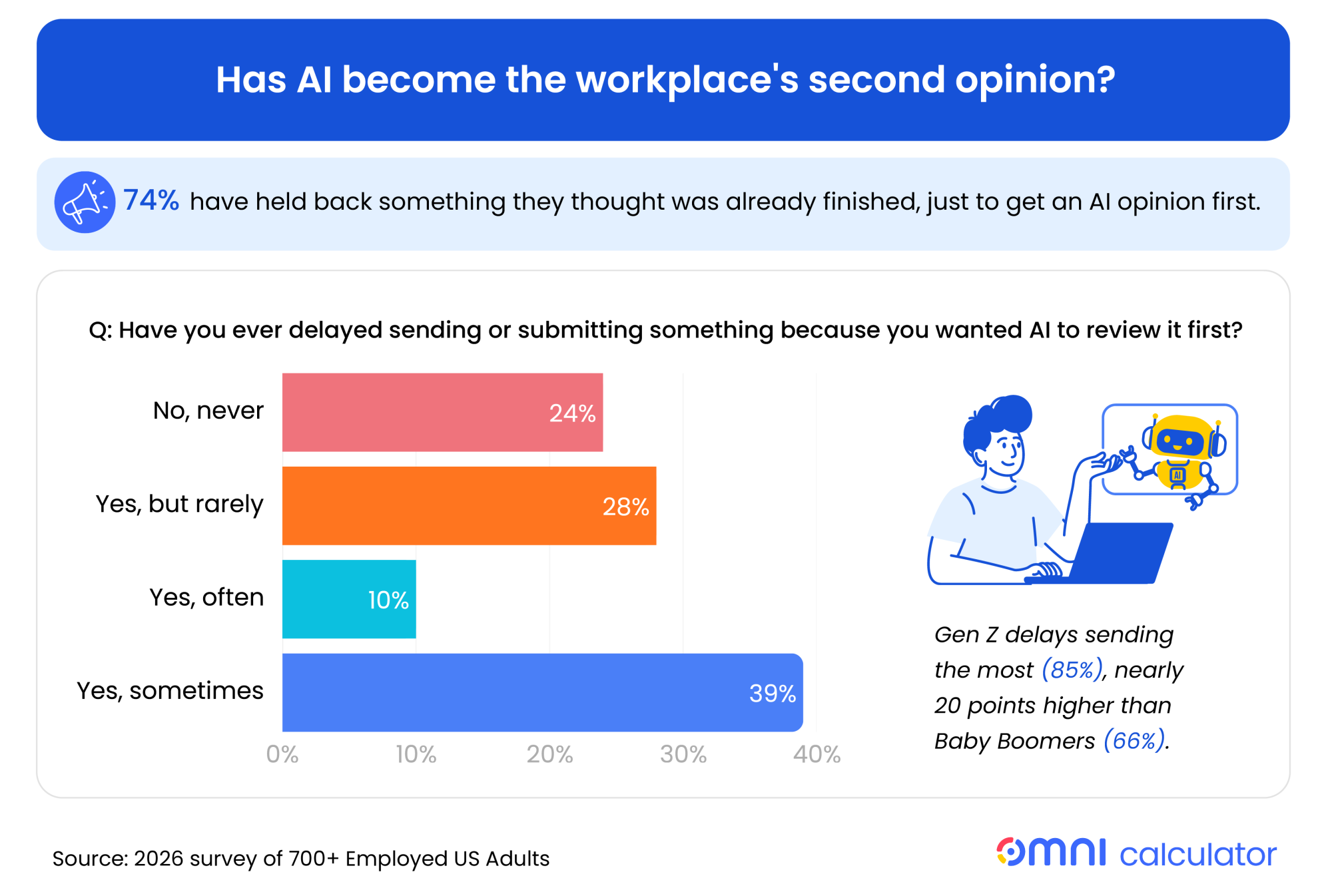
We asked this in two different ways and got the same answer both times. 77% say they’ve delayed sending or submitting something specifically because they wanted AI to review it first. Asked a different way — whether they’ve ever held back something they considered already finished, just to check with AI before sending it — 74% say yes. Two different questions, worded to catch two different mental framings of the same behavior, converged on nearly the same number, indicating a broad behavioral pattern.
ai-as-second-opinion
Has AI become the workplace's second opinion?

That's what makes AI's new role different: it's no longer just helping people write. It's helping decide when what they've written is ready.

Age is the sharpest dividing line. 85% of Gen Z workers have delayed sending something for AI’s review, compared with 66% of Baby Boomers. It isn’t just that younger workers do this more often; they do it more habitually: 64% of Gen Z say they delay often or sometimes, compared with 41%-42% of Gen X.

The career stage tells a similar story. Entry-level individual contributors report the highest delay rates of any professional group (82%). In contrast, executives report the most autonomy to send without waiting, though even they delay 70% of the time, the lowest rate of any corporate role, but still a clear majority.

Age

Yes

No

18-29 (Gen Z)

85%

15%

30-45 (Millennials)

76%

24%

46-61 (Gen X)

75%

25%

62-80 (Baby Boomers)

66%

34%

Gender, education, and geographic region showed no meaningful effect on this behavior.

Waiting for AI’s opinion would matter less if that opinion didn’t actually change anything. It does. This suggests that AI is becoming more than a second opinion. When its feedback can determine whether something gets sent at all, AI has effectively become part of the gatekeeping process.

73% of workers say AI’s feedback has directly changed whether or how they sent something. Of those, 34% asked AI to fix a flagged draft itself, 23% fixed it themselves after AI flagged it, and 15% sent something specifically because AI told them it was good to go, meaning they wouldn’t have sent it otherwise. Only 27% say this has never happened to them.

73% say AI’s feedback has directly changed whether or how they sent something, and almost no one abandons a flagged draft outright (just 1%). This shows AI critique refines communication, and it rarely kills it.

Role level is where this splits most sharply. 81% of executives and 78% of managers say AI has changed their sending behavior. Both are roughly twice as likely as entry-level individual contributors (13%) to send a document specifically because AI confirmed it was ready.

Not all writing gets the same scrutiny. We asked workers how likely they are to run nine different types of communication by AI before sending, and the pattern that emerged is remarkably consistent: the higher the stakes, the more likely AI gets consulted first.

Job applications and cover letters top the list; 81% of workers have run one by AI before sending. Public content, emails to colleagues, emails to a boss, and meeting notes all cluster closely behind, between 76% and 77%. Performance reviews sit at 70%. At the bottom of the hierarchy: a Slack message to a colleague (52%) and, at the very bottom, a text to a close friend (39%) — less than half the rate of a job application.

Forced to pick just one message type, workers are just as consistent. 61% say a high-stakes application or review is what they’re most likely to check with AI; only 5% say the same about a personal message. The higher the stakes, the more likely AI is to be invited into the decision.

Platform Beats Hierarchy:
Workers appear more likely to seek AI’s input for formal or permanent communication than for real-time communication, even when the recipient is exactly the same person. 76% run an email to their boss by AI before sending. Only 58% do the same for a Slack message to that same boss.

The comparison suggests that the medium itself can significantly shape whether workers seek AI’s input, even when the recipient is identical. One possible explanation is that workers perceive email as more formal or permanent than real-time chat.

Most workers say they use AI to check practical things such as grammar and clarity. But the way they respond to AI’s feedback suggests something more is happening.

  • 77% check grammar and clarity. Yet 79% have changed writing based on AI feedback, even when they already thought the original was fine.

If AI’s role were purely mechanical — catching typos, fixing grammar — that second number shouldn’t be nearly as large as the first. Instead, it’s larger. The gap suggests AI is functioning, for a majority of workers, as something closer to a confidence check than a spell-checker: not just “is this correct, “ but “is this good enough.” And once "is this good enough?" becomes a question workers routinely ask AI before sending, the second opinion starts to function like a gatekeeper.

The habit of checking is itself unevenly distributed. 45% of men have formed a high-frequency AI-checking habit (reviewing 70% or more of what they write before sending), compared with 38% of women. And women are nearly twice as likely to say they rarely or never check at all (15% vs. 9%). Notably, that gap disappears entirely for high-stakes messages specifically, where both genders check at almost identical rates (~30%). The difference isn’t in judgment about what matters. It’s in everyday default behavior.

Role

High-frequency AI checker

Modifies writing even when already confident

Manager

54%

85%

Executive

48%

81%

Entry-level IC

42%

85%

Experienced IC

30%

80%

Non-working/retired

24%

62%

If AI checking were mainly a symptom of inexperience, we might expect junior employees to rely on it most heavily. But the survey suggests the pattern is more complicated.

Across nearly every question in this survey, managers and executives check with AI more than the individual contributors they oversee, not less. They’re more likely to run an email to a colleague or their boss through AI before sending it. 81% of executives and 78% of managers say AI has changed whether or how they sent something; both are well above the entry-level rate. And they form high-frequency AI-checking habits at rates higher than those of experienced individual contributors (54% and 48%, respectively, versus 30%).

The Managerial Paradox:
AI-checking is not simply a junior-worker behavior. Managers and executives repeatedly emerge as among the heaviest users of AI for a second opinion.

A reasonable explanation is that leaders and executives are reaching for it because they handle so much of high-stakes communication. A performance review, a message to a direct report, a note to their own boss: these are the exact categories this report already shows get checked the most.

Everything so far describes behavior, what workers do before hitting send. This section asks a different question: what happens when you repeatedly let an external system approve your decisions?

32% of workers say they feel less confident in their own writing since they started using AI, compared with 23% who feel more confident; the rest (45%) report no change. That’s a real, if modest, shift on its own. But it isn’t distributed evenly — and the way it isn’t distributed is one of the cleanest findings in this entire survey.

42% of Gen Z workers feel less confident in their own writing since they started using AI, which is roughly double the rate of Baby Boomers (21%).

The finding moves in a clean staircase by generation, not just at the extremes. 42% of Gen Z report feeling less confident, dropping to 33% for Millennials, 25% for Gen X, and 21% for Baby Boomers. Each generation up the ladder reports less erosion than the one below it. The workers who grew up with AI are the ones reporting the steepest decline in trusting themselves to write without it.

Read on its own, the last section could suggest AI is broadly undermining how workers feel about their own writing. That’s not quite what the fuller picture shows.

Sorted into three groups, 74% of workers fall into what this report calls the “Pragmatic Safeguard” camp: they trust their own writing, but treat AI as a routine, expected check before sending — not something they consider optional. 10% are “Fully Independent,” rarely needing AI at all. The remaining 16% are “Reassurance-Driven,” showing more overt dependence: feeling better only after AI has reviewed their work, or genuine discomfort sending anything without it.

Only 10% fall into the Fully Independent group. But that does not mean the other 90% lack confidence in their own writing. For most, trust and AI use appear to coexist. They still believe they can write on their own. They have simply added a second opinion to the process. Most workers haven’t stopped believing in their own judgment. They’ve just stopped believing it’s complete without a second opinion first. In other words, AI doesn't have to replace someone's judgment to influence the final decision. It only has to become a routine checkpoint before that decision is made.

Role

Fully Independent

Pragmatic Safeguard

Reassurance-Driven

Entry-level IC

16%

63%

21%

Manager

10%

73%

17%

Experienced IC

7%

81%

12%

Executive

6%

73%

21%

Experienced individual contributors are the most self-assured group in the survey; 81% Pragmatic Safeguard, the lowest independence rate, but also the lowest dependence. Executives and entry-level workers land at the identical 21% Reassurance-Driven rate, but for different reasons: executives are more often seeking final reassurance on high-stakes communication, while entry-level workers are more often still building foundational confidence in their own writing.

Given how deeply AI has embedded itself into the sending decision, you might expect workers to be talking about its role more. They aren’t.

  • 76% of workers default to never (53%) or rarely (23%) telling the recipient that AI reviewed or helped write something they sent. Only 7% disclose routinely.

76% default to never or rarely disclosing AI’s involvement, but only 11% stay quiet out of fear of judgment. For most respondents, it isn’t about secrecy. The stated reasons suggest that many see AI assistance as routine or irrelevant to the recipient.

The reasons behind that silence are almost entirely mundane rather than guilty. 30% say the recipient simply doesn’t need to know. 23% consider the final writing to be their own, regardless of AI’s involvement. 21% say AI only corrected grammar or wording. Combined, 81% of non-disclosers point to some version of “this is still basically mine” or “it’s not relevant”, while just 11% cite fear of being judged or looking less capable.

Managers (29%) and executives (31%) disclose at nearly double the rate of experienced individual contributors (17%), another entry in the Managerial Paradox running through this report. And when executives do stay quiet, their reasoning stands out: 40% justify it through ownership specifically; “I consider the final writing to be my own”, roughly double the rate at any other level, even though executives are, by this report’s own data, among the heaviest AI-checkers in the entire workforce.

AI is moving from assistant to second opinion, and from second opinion toward something closer to a gatekeeper. Workers aren’t simply using AI to generate text. Many now place it between themselves and the send/submit button, checking in before they commit to something they’ve already written.

That distinction matters.
A writing assistant helps you produce something. A gatekeeper helps determine whether what you've produced is ready to move forward. This survey suggests AI is increasingly doing both.

The bigger long-term question may be confidence. The more interesting long-term question this data raises may not be whether AI gives good or bad advice, but whether routine reliance on it changes how confident people feel making judgment calls on their own.

AI dependence isn’t limited to junior workers. Managers and executives emerge repeatedly as some of the heaviest users of AI checking and reassurance, often more so than the individual contributors they oversee.

The stakes shape the behavior more than the relationship does. A message’s format and permanence — an email versus a Slack ping, a job application versus a text to a friend — predicts AI-checking more consistently than who’s on the other end.

Disclosure hasn’t caught up with adoption. Most workers don’t mention when AI helped, not out of shame, but because they consider the final writing their own, regardless of how much AI shaped it.

The survey polled 705 employed US adults who use AI tools for writing at work, school, or in their personal lives, via Prolific. Respondents were screened for active AI use in writing tasks, ages 18 and older. Pearson’s chi-square tests were applied across all demographic subgroups, with findings reported at the 95% confidence level. Respondents who failed an embedded attention check were removed before analysis. Percentages may not sum to 100% due to rounding, and totals for multiple-choice questions may exceed 100% since respondents could select more than one answer.

Omni Calculator is a technology and research company that provides more than 3,800 calculators designed to help users make data-informed decisions across a range of professional and everyday topics.

Authors of the report

Ask the authors for a quote

Copyrights