
A Guide to Dress Sizes: Everything You Need to Know
Have you ever tried on a dress in two different stores and needed two totally different sizes? Have faith, you are not the only one. Dress sizing has to be one of the most incoherent aspects of shopping for clothing. A size that fits perfectly in one brand might not feel right in another. And once you add international sizing systems into the mix, well, things get out of hand really quickly, and you are stuck between conversion systems.
The truth is, dress sizes are not as straightforward as they seem. They are influenced by brand standards, body measurements, and even marketing strategies. But once you understand how sizing works, finding the right fit becomes much easier.
In this article, “A Guide to Dress Sizes: Everything You Need to Know”, you’ll learn everything you need to know about dress sizes, from how they’re determined to how you can measure yourself accurately. You’ll also discover how to interpret size charts, convert sizes across countries, and make confident choices when shopping online or in-store.
👗 A dress size is the number assigned to a dress or piece of clothing that indicates the body measurements it is designed to fit. It might seem like a universal system, but dress sizing is flexible and varied enough that it differs across brands and regions.
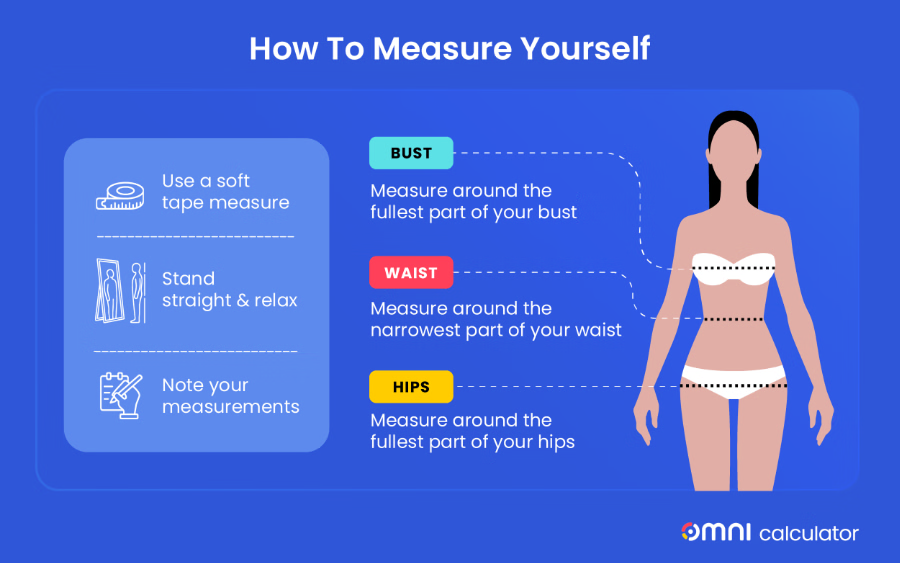
Dress sizes are generally based on three key measurements:
- Bust: the fullest part of your chest.
- Waist: the narrowest part of your torso.
- Hips: the widest part of your lower body.
These measurements serve as a reference point for creating dress size charts. But one thing that we need to remember is that these charts may vary across different brands. They might differ in their numbering systems or target varying body types altogether. The charts are also impacted by the fashion trends, which is why the same size can fit differently depending on where you shop.
It’s important to understand that a dress size is not an exact representation of your body. Instead, it’s a general guideline created by manufacturers. That’s why focusing on your measurements is always more reliable than focusing on the size label itself.
🙋 Myth vs. Reality
- A common myth is that dress sizes are standardized, whereas in reality, every brand uses its own system. This is something that you will learn in our guide to dress sizes.
Dress size measurements are widely used, but still, different brands interpret them differently. 🥻Which is why, in our opinion, understanding your own measurements is far more reliable than relying on a size label designed for different reasons.
 |
Enlarge image |
By following these simple body measurement guides, you can easily measure yourself and keep a record of your personal body measurements. And then, when needed, easily convert from one standard to the other.
This can come in handy, especially when you are shopping in person. As brands carry measuring tapes 📏. And if a dress size labeled ‘Small’, ‘Medium’, or ‘Large’ confuses you. Just use the measuring tape to quickly check the three key measurements mentioned above.
A dress size chart can come in handy in every dress shopping situation. Below is a size chart used as a baseline by many brands. Keep in mind that actual measurements can vary. Always compare your measurements with the specific brand’s size chart when possible.
US size | Bust (in) | Waist (in) | Hips (in) |
|---|---|---|---|
2 | 32 | 24 | 34 |
4 | 33 | 25 | 35 |
6 | 34 | 26 | 36 |
8 | 35 | 27 | 37 |
10 | 36 | 28 | 38 |
12 | 38 | 30 | 40 |
The dress size chart shows the standard dress sizes used by most US brands, along with their corresponding bust, waist, and hip measurements.
✅ Can you imagine getting rid of the hassle of remembering all the inputs and measurements you used while using the dress size calculator? Create a free account to easily go back to all your saved calculators. 🤓
There would be times when you would want to keep it even simpler and just go with the letter sizing, which is another standard for measuring dress and clothing sizes across different brands.
The chart below is a dress size guide that converts US dress sizes to letter sizing.
US Size | Letter Size |
|---|---|
0 | XXS |
2 | XS |
4 | XS |
6 | S |
8 | S |
10 | M |
12 | M |
14 | L |
16 | L / XL |
18 | XL |
20 | XXL |
22 | XXL / 3XL |
24 | 3XL |
How about we make things simpler for you? Just hop on to our dress size calculator. And forget about all the fuss that comes with knowing and remembering dress sizes and their conversions.
🙋 Myth vs. Reality
- Another myth is that the same size always fits the same, whereas in reality, fit varies by design and fabric.
Accurate measurements are essential in dress sizing because they provide a consistent and reliable way to find well-fitting clothes, especially when size labels vary across brands.
- Sizes are not standardized, so accurate measurements give you a reliable reference point.
- They ensure a better fit, improving appearance and comfort.
- Essential for online shopping, reducing the chance of an incorrect order.
- If you have the right measurements, you get your order right the first time, reducing returns and saving money.
- Correct measurements come in handy in navigating different brands.
- Accounts for fabric and fit differences, allowing you to jump from fabric to fabric easily.
- Your tailor relies on the body measurements you provide, so accurate measurements support custom and tailored clothing.
- Tracking your measurements ensures your wardrobe keeps up with your body.
💡 Tips for accurate size measurements
- Use a flexible measuring tape;
- Keep the tape snug but not tight;
- Stand straight and relaxed; and
- Measure over-fitted clothing.
Now that we understand what a dress size is, let’s talk about something that makes our guide to dress sizes even more interesting.
👚 It is very common for people to get caught between two different sizes when shopping. Most people do not fit into a labeled box, and neither do your measurements.
Here is a short guide to help with your decision:
-
Check the fabric
Is there some stretch to it? If the fabric is stretchy, it is safe to say you can go with the smaller size. Choosing a smaller size gives you a nice, snug fit.
Is the fabric sturdy? If you see a fabric that is overly made of denim, cotton, or linen, you should go up a size. You should choose a larger size for more room, so you can be comfortable and move.
-
Consider the shape
Bodycon dresses are more picky. In those cases, you should consider your widest measurement.
With an A-line or a loosely fit dresses, there is more freedom. You can consider the fit in the shoulders or the bust, and the fabric will fall as it should.
-
The main rule is to size up
If it’s between two sizes, choose the larger size. It is easier to get a dress tailored that’s a little big than one that’s too small. Most importantly, a dress that’s too small will be uncomfortable to wear, and a big dress will make you feel more confident!
The most important thing to keep in mind is choosing what makes you comfortable. You should choose a size that suits your preferences and comfort. Not what the label says. At the end of the day, it’s all about what makes you feel confident in what you wear and how you carry it.
🙋 Myth vs. Reality
- According to a myth, a smaller dress size is better; in reality, proper fit is what matters.
Sizing has changed significantly across different types of clothing. Looking back to the 1900’s, the means of clothing production was tailoring or home-sewn clothing. That meant the clothes were not sized and were made to the precise measurements of the person they were being made for.
Standardization of clothing and measurements started in the 40’s and 50’s. Originally, in the USA, measurements started to be collected, and a label was designed. This system started imperfectly. This was due to the limited data on measurements, which failed to represent all body types and was almost non-inclusive.
Because of ready-to-wear fashion 👘 in the 60’s and 70’s, sizing became more systematic and much more standardized. However, due to constant variation in measurements across brands, a size 10 from the 60’s can look so different from a modern size 10, and even more so, with greater variety and contrasts.
The 80’s saw a lot of vanity sizing, meaning that when clothing was made with larger measurements, it was labeled with smaller size designations. This meant large differences in sizing, with clothing measuring even larger sizes or being a smaller labeled size than in the past.
🧥 Understanding clothing size labels is more important than ever, as global fast fashion has created a more complex international sizing system. In a single global market, clothing is manufactured in various countries and designed for a wide range of body shapes. Sizing may be more inclusive than ever before, but inconsistency compounds the difficulty of understanding clothing measurements.
This article was written by Komal Rafay and reviewed by Steven Wooding.