
Whether you run hundreds of AI prompts daily or just a few, our AI water footprint calculator estimates the AI environmental impact of your queries. Think of every AI query as demanding a hidden amount of water. The amount of power used to generate those millions of AI-generated answers daily means data centers actively need to use water-based cooling systems to prevent overheating.
With more people adopting AI worldwide, this "hidden" water cost mounts up rapidly. This tool estimates the water and energy needed to process your searches based on the large language model you're using and the volume of queries you process each day, allowing you to convert your daily artificial intelligence usage into actual resource costs.
We know you can't quit AI — it's practically essential — but you can use it smarter! If you're concerned about a sustainable digital future and don't want your online activism to cause a micro-drought, read on to learn more about the hidden AI water consumption and AI energy consumption.
Unmasking the full AI environmental impact
The accelerating integration of artificial intelligence into every facet of our lives — from search engines and digital agents to everyday apps for shopping or fitness — is masking an astonishing and often invisible resource cost. We should be asking a simple question: How much energy does ChatGPT use to resolve a single AI query? The answer is vitally important because these individual queries quickly compound into a tremendous ecological impact.
This effect primarily results from the training and deployment of large language models that happen inside servers located within massive data centers, which require energy to operate. According to the , data centers consumed about 4.4% of total U.S. electricity in 2023 and are expected to consume approximately 6.7% to 12% of total U.S. electricity by 2028.
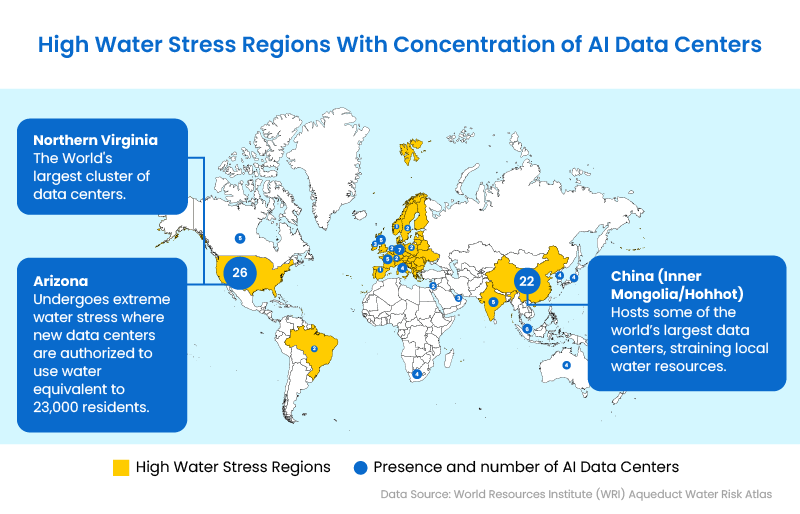
Yet, we must look beyond the energy consumption of AI. The millions of gallons of water necessary to cool these servers is a problem that mostly goes unnoticed but is quickly escalating.
💡 Here is some interesting data on the water footprint and energy consumption of a regular AI tool user:
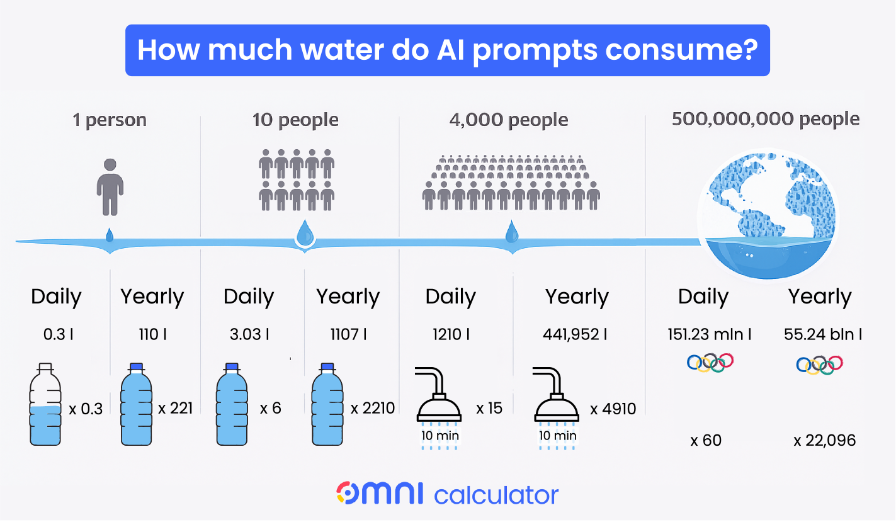
- An average 100-word email generated by GPT-4 consumes around 500 milliliters of water, the equivalent of a standard single-serving bottle.
- A querying habit of generating 50 prompts a day for a year could be enough to take up to 38 relaxing 15-minute showers.
- Assuming ChatGPT water consumption is estimated at 1.174 billion gallons of water each month, this is the equivalent of filling up 1,780 Olympic-size swimming pools.
Why does AI need so much water? — AI water consumption
In short, a data center is a massive, temperature-controlled warehouse that stores heavy machines, including servers and storage devices. Although data centers have been in existence for some time, the rapid development of generative AI has necessitated the construction of new server rooms.
There are growing discussions on the high electricity requirements of these facilities, though it's equally important to consider the amount of water they consume. AI servers generate immense heat when processing queries. Every single request triggers computations that force data centers to activate their water-based cooling systems, causing a continuous supply of freshwater to be constantly evaporated just to keep the AI center operational. It is also important to note that the most common source of this freshwater is potable (drinking-quality) water from local supplies.
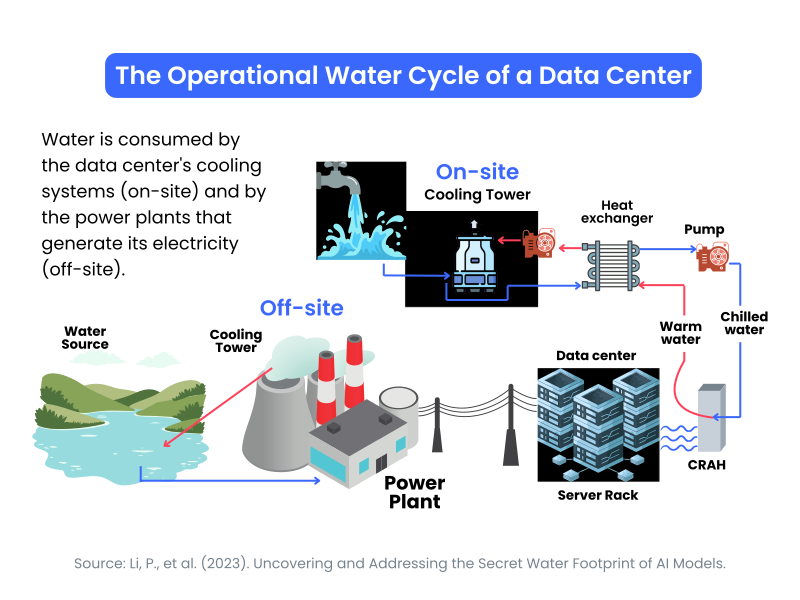
The whole AI water consumption can be broken down into three areas:
- On-site: the water used directly at the data center for cooling the servers.
- Off-site: the water consumed by power plants to generate the electricity that runs the AI.
- Supply-chain: the water used in the manufacturing and production of the actual servers.
On the first stage, the energy in the server is converted into heat. In simple words, the servers "sweat" and need to be cooled down — a process that happens in water-intensive cooling towers. Here, part of the water is inevitably evaporated once the heat dissipates into the environment — the first instance where water is consumed or wasted. Following this step, freshwater must be continuously added to the cooling tower to recycle the remaining non-evaporated water, resulting in increased consumption.
At the off-site stage, large amounts of water are also required to operate the power plants that supply their cooling towers. This consumption is considered another massive part of the true water cost of AI.
Our AI water footprint calculator aims to quantify the water and energy consumption of running queries on various large language models. Let's explore how it works in practice.
How to use the AI water footprint calculator
Using Omni's AI water footprint calculator to get an idea of the amount of water your use of generative AI consumes is very straightforward.
-
Select an AI model to analyse from the dropdown list. You'll see we have most of the popular standard and reasoning models:
- ChatGPT (GPT-5, OpenAI);
- Gemini (2.5 Pro, Google);
- Claude Sonnet (4.5, Anthropic);
- Cluade Opus (4.1, Anthropic);
- DeepSeek V3;
- DeepSeek R1;
- Llama (3.1, Meta); and
- Grok (4, xAI).
-
Enter the average number of queries made in a day. Also, remember to include any follow-up questions. To get you started, we set the default to 8, which is the average daily usage of ChatGPT users.
-
Select a preset number of users to calculate for; either just you, where you work, or all current AI users.
-
Results time! In the Water footprint section, we provide you with the average water usage per query, along with your total daily consumption.
But how does that add up over a year? We also convert that large number into three relatable things: taking a shower, drinking bottles of water, and flushing the toilet.
-
Finally, we also provide you with an Energy footprint, looking at the amount of energy used for each query and your daily usage. Then we see how many kettles you could boil, smartphones you could charge, and hours of TV you could watch over the course of a year using that energy.
For these calculations, we have assumed a medium-length query of approximately 667 words, both input and output.
Strategies for a more sustainable AI
If you want to make AI greener, you can start by reducing your AI impact by:
- Looking for the most efficient large language model — one that requires a low AI energy consumption through credible research and the help of our AI water footprint calculator.
- Being sensible when writing prompts and treating each one of them as a resource. Multiple attempts double your AI footprint.
- Keeping the outputs short by adding a simple instruction in your prompt to limit an AI's response length (such as asking for a specific word count or number of sentences).
The engine of the calculator: transparency behind the numbers
A significant problem is the lack of transparency from commercial AI providers regarding the amount of water and energy they use to train and run their models. Instead of disclosing AI energy consumption per model, they aggregate emissions across their entire cloud infrastructure, making it impossible to see the cost of a single AI query.
In order to provide you with accurate results, we based the algorithm behind this calculator on a data dashboard called created by Nidhal Jegham, an AI Sustainability and Data Science Researcher at the University of Rhode Island. The methodology for determining the water and energy usage of AI is outlined in the paper written by him and other researchers.
In their research, they introduce a new framework for measuring the environmental footprint of queries. Beyond the one-time training cost of an AI model, they state that the real AI energy consumption is due to constant running queries — also known as "". Their methodology relies on the following three criteria:
- Performance of metrics: combining public performance data (such as speed and latency) from AI models to determine how fast they respond.
- Hardware configurations: using these results to statistically determine what kind of hardware (or servers) is running on each specific AI model.
- Environmental data: applying region-specific environmental metrics (such as location-specific carbon intensity and water usage effectiveness) to calculate the final amount of water and energy for each query.
To summarize, their study presents a novel and transparent approach for benchmarking the sustainability of different AI models, revealing the actual environmental impact of AI and its associated costs.
FAQs
Why is AI water usage bad?
This AI resource consumption is harmful as it removes millions of liters of water from local supplies around the world, competing with the needs of humans, animals, and agriculture, and adding more stress to the already existing climate challenges. Besides this primary source, data center water usage comes from withdrawing water directly from natural sources, such as rivers, lakes, and groundwater.
Why do different AI models have different water and energy usage?
These variations in AI water and energy consumption depend on the internal size of each model and on its external location and infrastructure.
On the model itself, the following two factors have an impact on water and energy resources:
- The number of "parameters" used. Parameters are essentially weights and connections needed by a model during its training phase to make predictions. The more parameters involved, the more energy and heat are required; therefore, more water is demanded to cool down the systems.
- The efficiency of each model. Some models use fewer calculations by processing multiple queries simultaneously, making them more efficient and less energy- and water-demanding.
On the external location and infrastructure side, these two other factors also influence:
- The water usage effectiveness (WUE) can drastically influence the AI environmental impact. If the cooling system used to cool the servers is advanced enough to eliminate the need for water, the AI's water footprint will be minimal.
- The power usage effectiveness (PUE). Likewise, if the source of electricity that powers the data center comes from solar or wind technologies, rather than a coal plant, the footprint is significantly smaller.
Does generating images or videos with AI use more water than text queries?
The amount of resource consumption is directly linked to the computational complexity of the task. So if you're trying to generate an image or a video through an AI model, it will have a greater AI water footprint than a simple text query.
Generating an image requires a complex mathematical process and numerous iterations. This ensures that the output image is high-resolution and coherent with the text prompt you write.
When it comes to videos, it is currently the most resource-intensive task for AI. This is because a video is a sequence of many high-resolution images that require a massive computational load, resulting in the highest energy demand. This process puts a lot of pressure on the data center cooling stations, therefore, demanding the highest amount of water.
What steps are big AI corporates trying to implement to reduce data center water usage?
Though we don't see many actions being taken to reduce the AI water footprint, we know that some environmentally conscious providers, which represent a minority, are starting to make efforts. For instance, as an alternative to sourcing freshwater from local and natural supplies, some providers treat and recycle wastewater or rainwater, which is safe for industrial use but not for drinking.
Major internet companies, including Google, Microsoft, Amazon Web Services, and Meta Platforms, have already announced their plans to be water-positive by 2030.
Big data providers such as Google Cloud and Meta Platforms are already reporting lower power usage effectiveness in comparison to other average data centers, according to the Uptime Institute's .