
How Old Is My Cat Really? Understanding Cat Aging and Life Stages With Simple Math
You’ve probably heard that one cat year equals several human years, but how old is my cat really? The truth is, cats don’t age at a steady, predictable pace: their early years are full of rapid growth, while later years slow down significantly. Learning how to tell how old a cat is becomes especially important if you adopted them later in life.
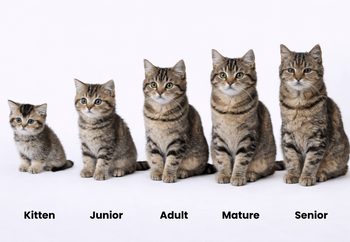
Cat age in human years reveals how dramatically a cat’s life changes over time. That’s why this guide follows a simple learning path built around the main stages of a cat’s life:
- Kitten: How a 1 year old cat compares in cat years to human years.
- Junior: At what age do cats stop growing?
- Adult: How to estimate how old a cat is in human years using a clear cat age chart.
- Mature: How aging slows and how cat years to human years change over time.
- Senior: How old is a 20-year-old cat in human years?
![]() |
|---|
Five life stages of a cat shown side by side. |
📢 A new feature is coming: create your own calculators!
We’re about to launch a feature that will let you build, edit, and share your own custom calculators. This feature will be available to signed-up users, so you can register for a free Omni Account.
This first phase is the fastest and most intense stage of your cat’s life. In the first weeks, your kitten is entirely dependent. Newborns are born with closed eyes and folded ears. They have no teeth, their claws aren’t retractable yet, and they can’t regulate their own body temperature.
Within a few days, the umbilical cord falls off. At around 7-14 days, their eyes begin to open, and hearing soon follows. By 3 to 4 weeks, baby teeth appear, movement becomes more coordinated, and curiosity grows. Crawling turns into wobbly walking, and then into confident exploration.
At about 5 weeks, you can introduce wet kitten food alongside milk. By 6 to 8 weeks, most kittens are fully weaned, eating solid food, and exploring with fully developed vision and hearing.
As the nervous system matures, your kitten becomes more playful and socially aware. Regular vet visits for vaccinations, deworming, microchipping, and neutering (often around 4-6 months) lay the groundwork for long-term health. Offer a complete, balanced kitten diet rich in animal protein and feed small meals throughout the day.
This is also the time to shape habits; gentle handling, nail trims, tooth brushing, carrier training, and appropriate play with toys instead of hands. By the time your kitten reaches 6 months, their cat age in human years is already roughly equivalent to 10 human years.
Your cat isn’t a tiny kitten anymore. But they’re not fully grown either. This stage is often compared to the teenage years. Energy levels are high, boundaries are tested, and personality becomes more defined. If you’re wondering what age cats stop growing, in most cases, a 1-year-old cat is physically mature, though some larger breeds continue developing closer to 1.5-2 years.
In terms of cat age in human years, this stage mirrors adolescence — a 1-year-old cat in human terms equals about 15 years, which explains the bursts of confidence and occasional “attitude.”
Between 1 and 2 years, growth stabilizes, and cat years to human years follow:
human years = 15 + (cat years - 1) × 9
Growth slows compared to the kitten phase, but mental and social development continue rapidly. Junior cats need space to move, climb, and explore. Safe outdoor access can provide exercise and stimulation, but if that’s not possible, create an enriched indoor environment with tall scratching posts, interactive toys, and elevated resting areas. Bored cats often redirect their energy into unwanted behaviors.
Continue feeding a complete, balanced diet rich in animal protein, and monitor portions after spaying or neutering, as metabolism can slow. This stage sets the tone for adulthood; stay patient, consistent, and engaged.
This is your cat’s prime. Fully grown, confident, and settled into their environment, adult cats know exactly how they like things. Routines become important — feeding times, favorite sleeping spots, even the same daily patrol around the house or yard. Small changes in that routine can cause stress, so consistency matters more than you might think.
If you’re estimating cat age in human years, check out the cat age chart below:
Life stage | Cat age | Human age |
|---|---|---|
Kitten | 1 month | 1 year |
3 months | 4 years | |
6 months | 10 years | |
Junior | 1 year | 15 years |
2 years | 24 years | |
Adult | 3 years | 28 years |
4 years | 32 years | |
5 years | 36 years | |
6 years | 40 years | |
Mature | 7 years | 44 years |
8 years | 48 years | |
9 years | 52 years | |
10 years | 56 years | |
Senior | 11 years | 60 years |
12 years | 64 years | |
13 years | 68 years | |
14 years | 72 years | |
15 years | 76 years | |
20 years | 96 years |
Between 3 and 6 years, cats are roughly comparable to humans in their late 20s through early 40s. Converting cat years to human years during this stage shows that aging becomes more predictable and gradual. After the age of 2, you can estimate it using a simple formula:
human years = 24 + 4 × (cat years - 2)
Each 1 cat year in human terms now corresponds to roughly 4 human years.
Even though adult cats often appear perfectly healthy, regular veterinary checkups remain essential. Early detection of weight gain, dental issues, or subtle behavioral changes can prevent more serious problems later. Portion control is especially important: metabolism may slow, and excess weight can increase the risk of diabetes and joint disease. Use our cat BMI calculator to monitor body condition.
Adult cats still need enrichment. Scratching posts, puzzle feeders, interactive toys, and vertical spaces help maintain physical and mental health. Feed a complete, balanced diet rich in animal protein, vary textures when possible, and always provide fresh water away from food bowls.
This stage may look calm on the surface, but it sets the foundation for mature and senior years.
This is feline middle age. When you look at cat age in human years, this stage often corresponds to the mid-40s through mid-50s in people. Using a cat age chart or converting cat years to human years shows that each additional year still adds roughly 4 human years.
Your cat is still agile and alert, but subtle changes may begin to appear. Regular checkups become even more important. Blood and urine tests can detect early signs of kidney disease in cats, diabetes, or thyroid issues long before symptoms become apparent.
You may notice small behavioral shifts: sleeping a little more, playing a little less, drinking slightly more water. These changes can be normal, but they can also signal early illness. Keep routines consistent, as mature cats thrive on predictability.
Hydration becomes especially important at this stage. Wet food can help support kidney health, and multiple water stations may encourage drinking. Maintain portion control, since weight gain is common and increases the risk of chronic disease.
This stage is about awareness. Aging is gradual now, but attentive care makes all the difference.
Senior cats have earned their calm confidence. They prefer comfort, warmth, and familiar routines. If you’re asking how old a cat is in human years at this stage, each additional year still equals roughly 4 human years. So, how old is a 20-year-old cat in human years? According to a cat age chart, a 20-year-old cat is the feline equivalent of reaching one’s mid-90s. In the later cat life stages, even 1 cat year in human terms carries significant weight.
If you’re wondering how to tell how old a cat is, especially when you don’t know their exact birthdate, physical and behavioral changes can offer important clues:
- Gradual loss of the senses (reduced hearing, weaker eyesight, or increased vocalization);
- Coat changes (duller, thinner fur or new gray hairs around the face);
- Weight loss;
- Dental disease;
- Arthritis (hesitation before jumping or choosing lower resting spots); and
- Brittle, thickened nails or dry skin.

![]() |
|---|
An aging cat with graying fur, a natural sign of the senior life stage. |
Sleeping more, playing less, and moving carefully may be normal, but sudden changes are not. Regular veterinary screening is essential now. Blood, urine, and blood pressure checks can detect hidden conditions early. Hydration also matters more than ever — wet food and multiple water stations support kidney health. A practical pet quality of life scale can also help monitor overall well-being.
Senior cats still benefit from gentle play and mental stimulation, but adapt activities to their comfort level. Soft bedding, easy access to litter trays, and stable routines reduce stress.
Now you’ve walked through the main cat life stages. You’ve also learned practical ways to estimate a cat’s age in human years using both a cat age chart and simple formulas. Before you go, why not test your knowledge with our cat age quiz? 😺
This article was written by Joanna Śmietańska-Nowak and reviewed by Steven Wooding.

