
What Does It Mean to Grade on a Curve? The Philosophy of Relative Assessment
Many students ask themselves, “What does it mean to grade on a curve?” Well, it’s a tricky topic. Some love it, others dread it. It’s usually enough to pull a handful of students into the next grade bracket, miraculously saving a few from a fail, while leaving others in the red.
The concept behind the bell curve for grades is to shift the way we evaluate a test or an exam. Unlike in standard grading, where a 90 is always an A, when curving grades, we can evaluate based on the normal distribution, for instance. But what does this really mean?
In this article, we’ll see:
- The impact and meaning of curving grades;
- The difference between norm-referenced and criterion-referenced grading;
- The mathematics behind the bell curve for grades and how it shapes the distribution of scores; and
- A grade curve chart example to understand the meaning of curving grades.
🙋 Do you need to curve grades? Then use our grade curve calculator!
Most educators use criterion-referenced grading. It’s a strict system that defines the lower and upper boundaries of each grade. Get anything less, and you’ve failed, regardless of what your teacher thinks about it.
So, what does graded on a curve mean? It means shifting to norm-referenced assessment. It assigns grades based on a relative scale. This approach is particularly useful if a test went catastrophically badly — for example, if the class average was around 40% or 50%. In these cases, and if the institution allows it, the educator may decide to treat that 40% as ‘average competency’, normalizing everyone’s score accordingly. And magically, a 55% that would account for a fail according to a criterion-referenced system becomes a solid C.
When people ask “What does it mean to grade on a curve?”, they are almost always visualizing a specific geometric shape: the bell.
This shape is the Gaussian normal distribution, famously known as the bell curve. Its application to education has a fascinating, if slightly controversial, history. It was initially created for 18th- and 19th-century astronomy — mathematicians like Carl Friedrich Gauss used this distribution to map errors in astronomical measurements. Later on, it was applied to humans, as researchers observed that physical traits such as height or chest circumference tended to cluster around a mean.
Then, this system made its way into the classroom. The theory posits that intelligence or aptitude is a biological trait distributed like height. Therefore, in any sufficiently large class, the grades should form a bell curve.
- The majority of students (the hump of the bell) should perform according to an average (C or B grades).
- Fewer students should perform above average (B+ or A−).
- A tiny percentile should be exceptional (A).
- The same symmetry applies to the lower end (D and F).
While the philosophy is about relativity, the execution is pure mathematics. So, how are grades curved in practice? It is rarely as simple as adding 10 points. There are several statistical levers an instructor can pull to manipulate the distribution.
-
The linear scale
This is the easiest method. Essentially, the teacher takes the highest grade, calculates the difference between that grade and the maximum possible, and adds that difference to all the scores in the class. It’s fair and simple — everybody gets the same treatment, and the assessment is shifted from an objective (out of a total maximum) to a relative one.
-
The square root method
This method pulls the lowest grades up while keeping the highest roughly where they are. It compresses the distribution, pushing the bottom tail of the grade curve chart toward the middle.
-
Normalization
This is where the bell curve for grades is rigorously applied. The teacher decides what percentage of students receives a particular grade, and regardless of how well you scored, if you end up in that bottom group, you’ve failed.
🔎 Discover more about how grades are curved in “How to Grade on a Curve: Formulas and Methods”.
Let’s ground this theory in reality. What does this actually look like for a student waiting on a final grade?
Imagine a small class of 15 students who just took a difficult final and obtained the following results:
Student | Grade | Student | Grade | Student | Grade |
|---|---|---|---|---|---|
1 | 25 | 6 | 50 | 11 | 62 |
2 | 38 | 7 | 52 | 12 | 65 |
3 | 42 | 8 | 53 | 13 | 70 |
4 | 45 | 9 | 55 | 14 | 78 |
5 | 48 | 10 | 58 | 15 | 92 |
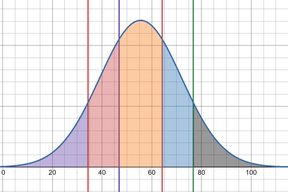
In a standard criterion-referenced system, anyone below a 60 fails. That’s 10 out of the 15 students. No teacher wants that, so let’s say that in this case, we want to apply the normal distribution to reflect the grading relative to average competencies. Here’s what it would look like on a grade curve graph:
![]() |
As you can see, when considering the normal distribution, the situation becomes significantly different. If we decide that only 10% of students shall fail, our pass threshold will be 34, meaning that we will fail only one student. On the other side of the spectrum, one additional student will receive an A instead of a C, as the top 10% of students fall above 76 points.
Thinking in absolute terms, this might not look fair — at the end of the day, the education system is pretty standardized, and we want all students across a country to be graded equally. On the other hand, if this test was indeed too difficult and demanded more than it should have at this point in the students' education, we may want to normalize the grades.
So, to answer the question “What does it mean to grade on a curve?”: The bell curve is an educational equalizer. It recognizes that if a class average is 55, the fault likely lies with the assessment’s design, not the students’ intellect. By shifting to a ranked distribution, we ensure that merit is measured against peer achievement rather than an unyielding and sometimes flawed numerical standard.
Yes. Scaling usually refers to adding a fixed number of points to everyone’s score (e.g., +5 points) without changing the shape of the distribution.
Curving often implies changing the distribution itself — forcing scores to fit a bell curve, which dictates exactly how many As, Bs, and Cs can be awarded regardless of the raw scores.
It means the GPA is not based on the difficulty of the exam. If it’s extremely hard, curved grades ensure the GPA doesn’t drop due to a low raw score. However, it also means a high raw score doesn’t guarantee an A if you don’t fall into the highest-scoring group.
This article was written by Agata Flak and reviewed by Steven Wooding.
