What can $50 buy? Why Black Friday Feels Different for Millennials and Gen Z
Report Highlights
-
The $50 bill's purchasing power has been nearly halved since 2000, transforming the Millennial's multi-item Black Friday haul into the Gen Z shopper's single, discounted purchase.
-
The shopping culture shifted from the Millennial era of physical doorbusters and stampedes to the Gen Z experience of strategic, digitally-native online bargains and "Lightning Deals."
-
Economic pressures force the modern Gen Z shopper to focus on securing a single, decent discount, replacing the Millennial thrill of acquiring a cheap bundle with the necessity of a rigorous financial assessment.
The year is 2000. A Millennial grabs a crisp $50 bill, ready for their first Black Friday haul. The promise of a loaded shopping cart is real. Now, fast forward to 2025. A Gen Z shopper, phone in hand, opens an app with the same $50.
How far does that same $50 stretch for a Gen Z shopper today?
This report tracks the economic change over two decades, revealing a stark generational gap defined by the decline in the $50 bill's purchasing power.

To illustrate the visceral effect of inflation, we compare what the same, nominal $50 cash could buy on Black Friday in both eras. The comparison highlights the dramatic shrinkage of the physical haul: The Millennial got a bundle; the Gen Z shopper gets a single item.
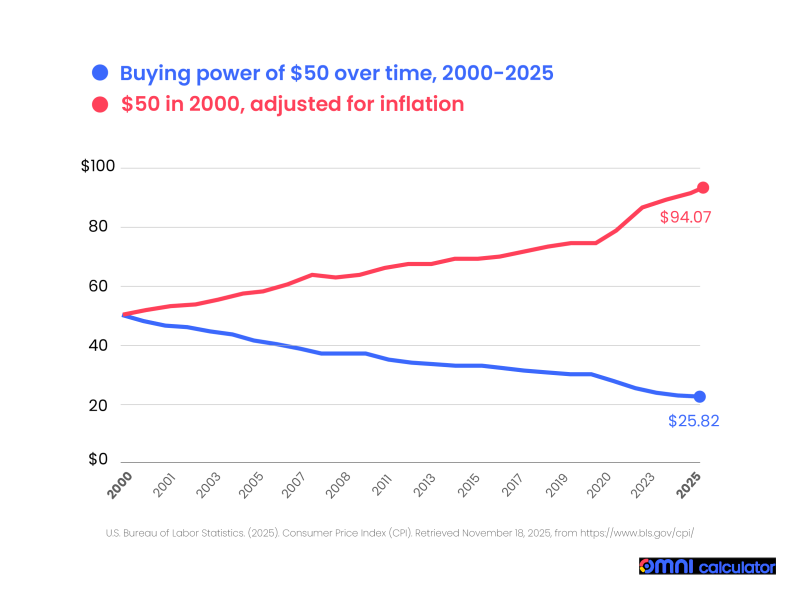
The decline in the physical haul is driven by one core economic fact: the $50 bill's value has been nearly cut in half.
To match the purchasing power of that $50 Bill in November 2000, a shopper today (November 2025) would need approximately $94.07.
This change represents a cumulative price increase of 88.14% over 25 years. Put simply: A dollar today only buys 53.15% of what it could buy back then.
For a more immediate calculation, you can use our dedicated inflation calculator to plug in any past dollar amount and instantly see its current-day equivalent.
The Modern Shopper's Mindset
This economic pressure changes how we shop. In 2000, the deal was the price itself; in 2025, the deal is often a percentage off a bloated original price. On the other hand, shows that shoppers are increasingly using AI shopping assistants to help filter deals and speed up purchase decisions.
That's why we've also created a free Black Friday calculator, assisting you to quickly compare the actual savings from a discounted item against its original price and your budget goals. This shift perfectly captures the Gen Z economic reality: every Black Friday purchase now requires its own line-by-line financial assessment.
While general inflation has soared, some Black Friday categories have been affected more than others. This explains why your $50 feels especially weak in certain aisles.
Black Friday | Inflation trend (2000 vs. 2025) | Impact on the $50 basket |
|---|---|---|
Apparel (Jeans, Sneakers) | HIGH INFLATION. The full price of a $30 item in 2000 should be around $56 today, but is actually $80+. | The Black Friday deal of $50 barely returns the item to its inflation-adjusted baseline. The $50 covers only the jeans, not the toaster and CD player, too. |
Small Appliances | MODERATE/HIGH INFLATION. The $5 doorbuster is now a $40-$50 centerpiece deal. | The $50 budget is completely consumed by a single, basic kitchen item (e.g., an air fryer). |
Electronics | THE PLOT TWIST (Deflation in Real Value). | While the headline price for new tech is high, the real price for equivalent functionality has crashed. A new video game should cost over $87 today (inflation-adjusted from $50 in 2000), but costs $70 or less. The $50 now buys vastly superior tech value, even if it's only one item. |