
History of DNA: Past, Present, and Future
DNA, initialism for deoxyribonucleic acid, is a rather complex molecule found in the nucleus of the cells of living beings. We'll discuss its structure in a moment; for now, it's sufficient to know that it enables the storage of massive amounts of information.
This information constitutes the blueprint to build an organism, the instructions needed to produce the materials, how to arrange them, and all additional information on characteristics and features. DNA decides if you will be an E. coli bacteria, a Triceratops, a , or a human. If you are a human, your DNA will determine whether you are a woman or a man, as well as your eye color, hair color, and other physical characteristics.
Life is complex. Even simple, single-celled bacteria are made of multiple components that interact in a complicated way if, and only if, everything is built to a T. For example, E. coli contains approximately 0.6 MB of data — it may not sound much, but it's enough to store 25 times the US Constitution.
How does DNA store this information? Let's take a look at the structure of this molecule. If you had a powerful enough microscope, and you looked at a section of DNA filament, you'd initially notice an elegant double helix structure.
A helix is a geometrical figure that you can imagine as being generated by a point on a propeller as it moves forward. The thread on a screw is a helix.
 |
|---|
DNA's older sister, RNA (ribonucleic acid), is a single helix molecule.
If you take the same propeller as before, and consider a point and the point diametrically opposite, and trace their paths as they move forward, you obtain a double helix.
 |
In DNA, the double helix we have just drawn is what is technically named sugar-phosphate backbone, and it repeats uniformly over the entire length of the molecule. On the inside of the double helix, molecules called nucleobases extend and pair from opposite sides of the backbone, in a shape that neatly reminds us of a spiral staircase.
There are four possible bases, marked with four capital letters:
- A for adenine;
- T for thymine;
- G for guanine; and
- C for cytosine.
These pair two-by-two according, forming two possible pairs:
- Adenine with thymine (A-T); and
- Guanine with cytosine (C-G).
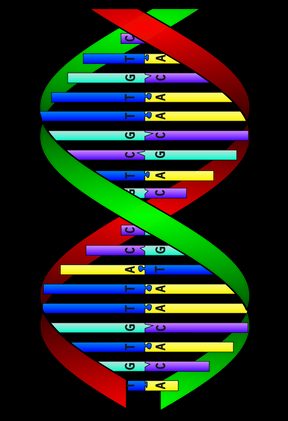 |
|---|
This effectively creates two possible "steps" in our staircase, and as 0s and 1s in a binary code, the way these pairs alternate allows the DNA molecule to store information.
That's all we need to know about the structure of this fascinating molecule: let's find out next about the origin of DNA!
For around four billion years, DNA conducted a quiet life — pun intended — orchestrating evolution, defining every living being that walked, flew, or swam (and everything in between). This peaceful anonymity was disrupted by a series of groundbreaking discoveries that allowed humans to peek all the way down to the molecules that make up life.
In the 19th century, Mendel laid the basis of genetics, the idea that traits (like the color of your eyes) are inherited according to how single genes — related to that trait — pass from parents to offspring.
Mendel's observations were at a "human scale", made by carefully breeding peas and observing generation after generation. At the turn of the century, scientists began relating genetics to parts of the cell: first the nucleus, then chromosomes within it.
The culminating discovery was made by Sturtevantin 1913, when he proved that genes are arranged linearly (one after the other) on chromosomes. The doors to the understanding of DNA's structure and role were open.
Around the same time, chemists were learning about the composition of what was inside the nucleus. By the beginning of the 20th century, bases were known, and not long after, evidence emerged that bases are paired in specific ways.
What was missing was a clear understanding of how bases and the sugar-phosphate backbone were arranged, and how this mattered in the way DNA works as the blueprint for an organism. DNA is small, its width oscillating between 1 nm and 2 nm (a nanometer, nm, is a billionth of a meter), just about 20 atoms wide. Even with today's TEM (transmission electron microscopes, the most powerful "conventional" microscopes available), it is barely possible to observe grooves in it. However, in the mid-20th century, a combination of wit and experience allowed science to discern that structure.
Enter Watson and Crick.
The first image of DNA with a recognizable structure is from 2012: . This is almost sixty years after we discovered the structure of this molecule!
The year 1951 marks the beginning of their collaboration. Their imagination and understanding of the chemistry of DNA will allow them, in a couple of years, to reliably understand and model the structure of the molecule. Some information was still missing to enable them to do so.
At the same time, Rosalind Franklin was an expert in X-ray diffraction, and was working together with other researchers on the DNA molecule.
🙋 X-ray diffraction is an elegant analytical technique, common in crystallography (the study of crystal) and chemistry. In a nutshell, a crystal is composed of regularly repeating facets, which interact with X-rays in predictable ways. The X-rays are collected, and from the resulting pattern, it is possible to infer the three-dimensional structure of a crystal.
DNA can form something akin to a crystal, on which scientists can perform X-ray diffraction. That's what Raymond Gosling, under the direction of Rosalind Franklin, did, producing the famous Photo 51.
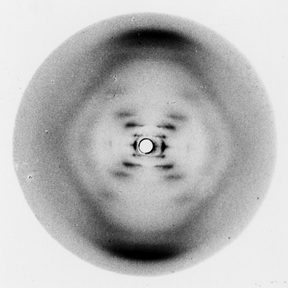 |
|---|
Photo 51 was then passed, without Franklin's consent, to Watson and Crick, who used it to corroborate the model they were developing. According to the "Cambridge model", DNA is a double helix structure where pairs of bases face inward, while the outside is composed of a structure of sugar and phosphates.
This discovery marked a turning point in the study of genetics. It was now possible to explain the mechanism by which DNA encodes information, and how this information is read and used to produce materials needed for life.
For the discovery of DNA's structure, Watson and Crick won the Nobel Prize in Physiology or Medicine in 1962, alongside Wilkins (Franklin's colleague, with whom she had a complicated dynamic). Franklin had passed a few years before due to cancer.
Her effort and brilliance, which led her nanometers away from visualizing the structure of DNA, went largely unrecognized until a few years ago, when the history of the discovery of the DNA structure was revisited. Tales of interactions, contrasting personalities, and what Nature defined the resurfaced, and today Franklin finally, albeit far too late, is regarded as one of the fundamental people that contributed to the development of genetics.